
Professional applications — France
Defibrillator drone in service in 32 communes of the Rouen metropolitan area
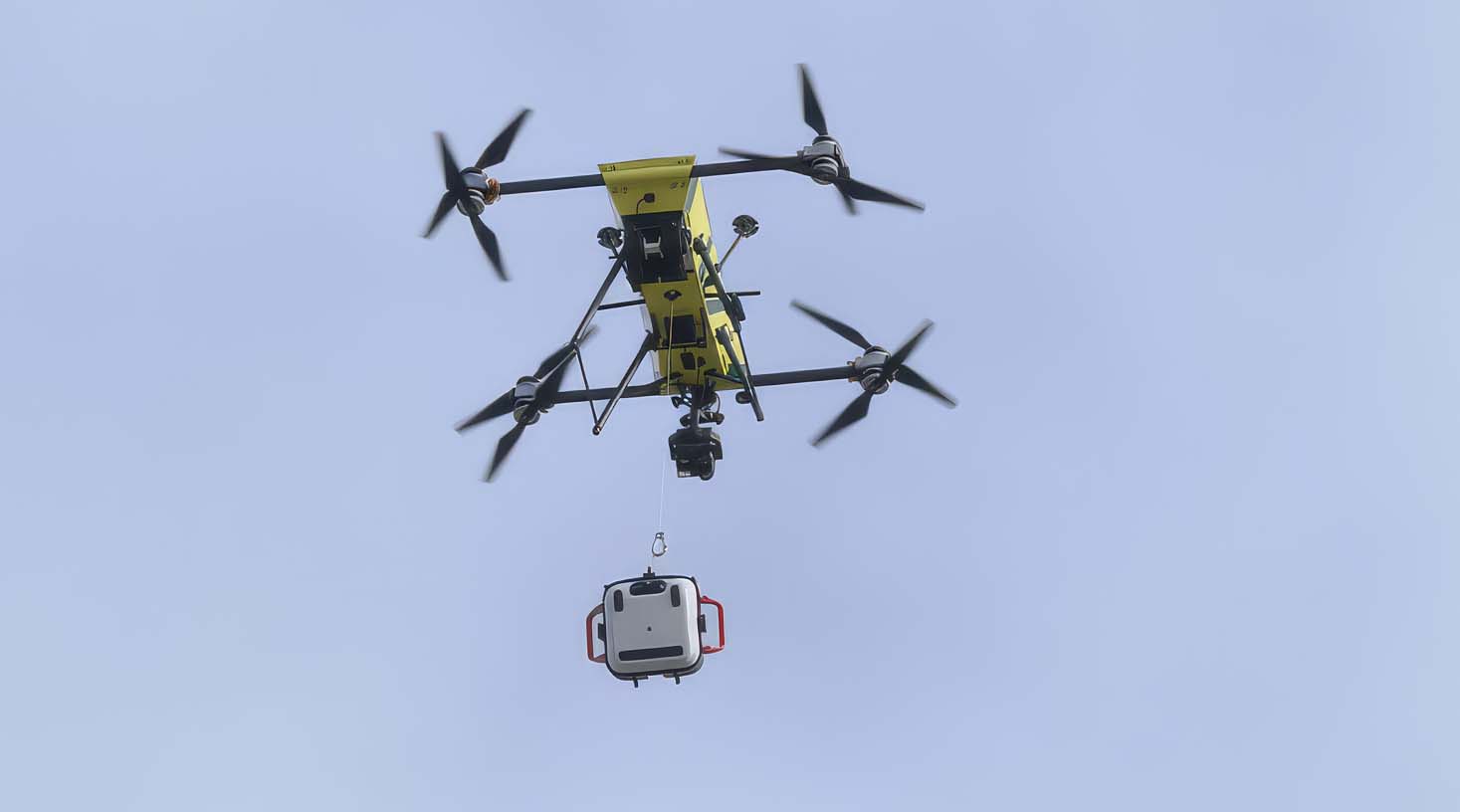
Activation and coordination with the emergency services
The call comes in to the medical dispatch centre of SAMU 76A, the CHU de Rouen branch. The request is passed to Delivrone, the operator. Fifteen seconds after the alert, the drone is activated. The chain has three identified links: the medical dispatch centre of the CHU de Rouen, the operator Delivrone and the bystander present at the scene. SAMU 76A is one of the department's two branches; the second, SAMU 76B, is attached to Le Havre. The CHU de Rouen hosts the medical dispatch centre for the former.
The criteria for deploying the drone are not described. Nothing indicates whether the dispatch centre selects it systematically or sends it according to specific conditions: distance to the victim, availability of a vehicle, nature of the call received on 15.
Bois-Guillaume base and 2024 trials
The drone takes off from a single base, located in Bois-Guillaume, a commune north of Rouen. The announced coverage radius is 8 kilometres. A circle of this radius delimits an area of around 200 km². The system serves 32 communes in the metropolitan area.
The trials took place in 2024. The number of flights carried out, the duration of the campaign, the weather conditions tested and the incidents encountered during the trial phase are not included in the information provided. Nor does anything indicate how much time separates the last trial from entry into service.
Time saved for bystanders
The time saving relies on the activation time, fifteen seconds after the alert, then on the flight. The bystander does not wait for the ambulance or the fire engine: they receive an automated external defibrillator, expose the victim's chest, attach the two electrodes. The device analyses the heart rhythm and delivers a shock if the rhythm justifies it. The procedure is guided by a recorded voice and, in parallel, by the dispatch centre over the phone.
The flight time is not provided, which makes it impossible to quantify the real time saving compared with an emergency vehicle. The further the victim is from Bois-Guillaume, the longer the drone's journey. Coverage stops 8 kilometres from the starting point. Comparison with a vehicle depends on traffic, which the parameters provided do not take into account.
Costs for an SDIS
No figures were provided on what the system would cost a departmental fire and rescue service. Neither the purchase price of a device, nor the maintenance cost, nor the cost of training remote pilots, nor the cost of an intervention is documented. The budget holder — SDIS, ARS, metropolitan authority or private operator — does not appear in the available information. The drone is presented as in service; none of the corresponding expenditure items is costed.
Funding, regulatory framework and transferable elements
Funding is not detailed: neither the amount invested, nor the split between local authorities and the operator, nor the duration of the commitment. Nor is the regulatory framework for the operation. A drone flying beyond visual line of sight over a built-up area falls under a scenario declared under the European regulations applicable to unmanned aircraft, with a defined operational area, a maximum flight altitude and procedures in the event of loss of link. None of these parameters is public for the Rouen system.
Four elements are transferable as they stand: a single base, an 8-kilometre radius, 32 communes served, activation in 15 seconds. An SDIS wanting to set up the same type of system should first measure population density within the radius, the frequency of cardiac arrests in the area and the existence of a site from which to launch the aircraft. The Rouen set-up combines a private operator with a CHU and a SAMU dispatch centre; this combination, as much as the machine, defines the system.
← Back to home · Search · Suggest a topic · Lire en français / Read in French