
Professional applications — UK
United Kingdom: a report warns about medical washing in drone delivery
The Birmingham report submitted to the Department for Transport
A British report on BVLOS drones flags a risk of “medical washing” in delivery operators’ communications. The document, entitled Medical BVLOS Drones: Wales and UK Perspectives, was produced by the University of Birmingham for the Department for Transport. It draws on two representative surveys, conducted among 695 residents of Wales and 3,588 people across the United Kingdom, and on focus groups bringing together 66 participants. The Civil Aviation Authority and the UK government are preparing authorisation for BVLOS operations, that is, flights beyond the direct line of sight of the remote pilot.
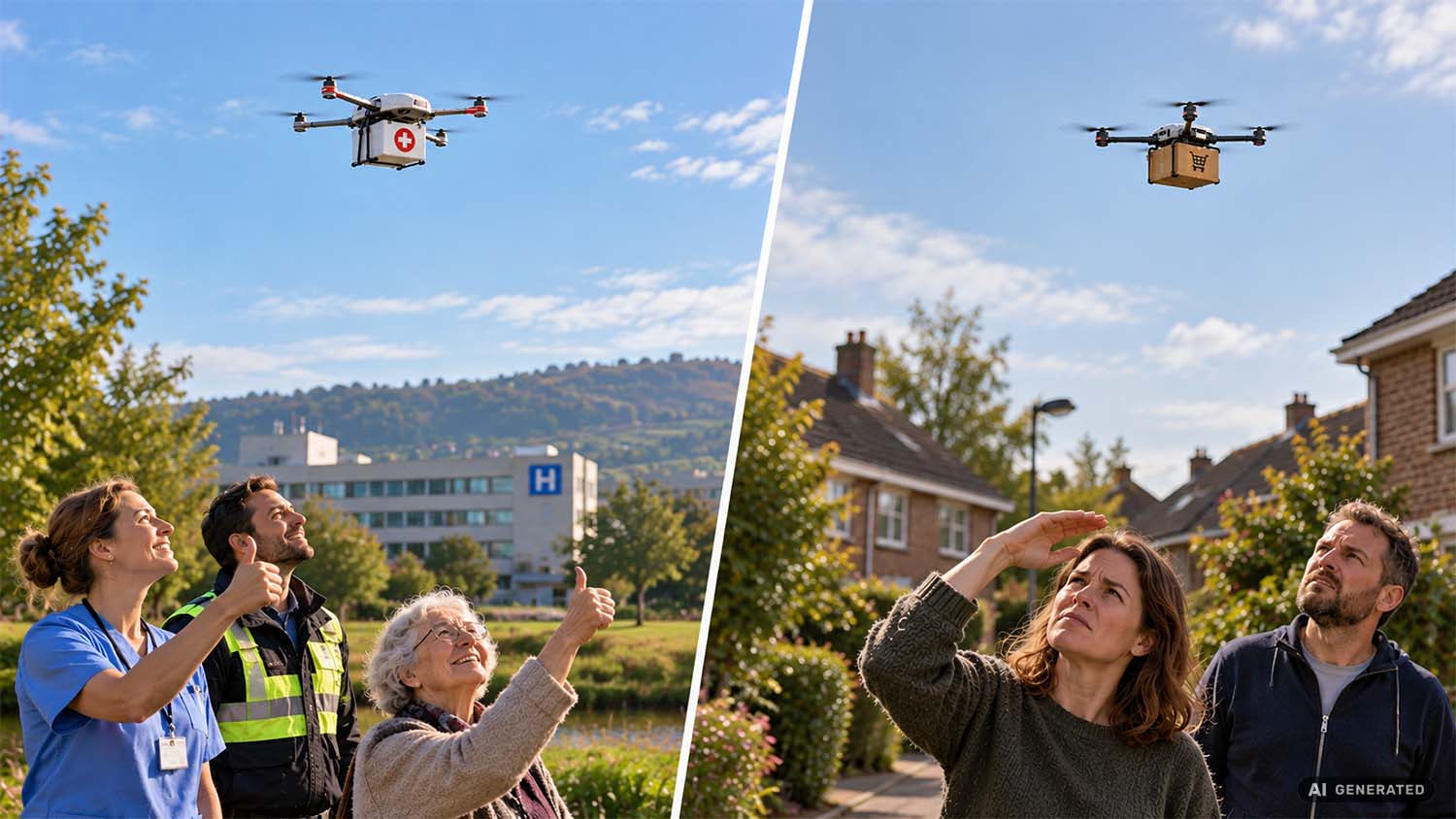
“Medical washing” refers to the use of socially useful medical applications as a stepping stone towards public or commercial drone services that enjoy less broad support. The researchers do not target any particular company. They observe that medical and emergency drones are often presented within a broader “drones for good” narrative, with the idea that positive uses improve public sentiment towards drones in general. The report considers this reasoning risky: a positive experience with a medical drone does not automatically make other BVLOS applications acceptable. The authors distinguish support for a specific health mission from acceptance of a drone delivery model extended to other uses.
Medical uses that gain support
The surveys confirm marked support for medical applications. Emergency response, the transport of blood and medical products, and logistics between hospitals are judged particularly useful. The perceived benefit is even stronger in rural and hard-to-reach areas, where distances and delivery times affect access to care.
Participants set conditions. They ask that operations be guided by real needs, with a clear explanation of the problem the drone solves and that cannot be addressed otherwise. Investments must demonstrate a net advantage over alternative solutions. Support for medical drones does not automatically translate into acceptance of other uses. The researchers emphasise this point: the positive associations generated by the “drones for good” narrative must not be used to accelerate public or commercial BVLOS services that are less well accepted. In the focus groups, participants return to the need to compare the drone’s cost, time and reliability with existing means, in particular helicopter, ambulance or road transport.
Wing and Manna cited for their medical activities
The report does not name any company. Two operators illustrate the mechanism described. Wing has worked with Apian and NHS partners to transport blood samples and other medical materials in London. Manna has partnered with Rotunda Hospital in Dublin to test flights of medical supplies and laboratory equipment. Wing and Manna use these medical missions in their communications while they develop commercial delivery services.
The report notes that medical delivery drones also raise concerns of their own. Participants cite cybersecurity, privacy, operational safety, noise pollution and impacts on wildlife. Participants apply these concerns to medical missions as well as to the commercial uses that accompany them. They ask operators to explain the overflight area, flight frequency, how collected data are handled and the measures taken to limit noise. These questions recur even when the mission is presented as a public service.
What participants demand from operators
The debate comes as the UK government and the Civil Aviation Authority seek to authorise BVLOS operations. BVLOS, or flight beyond direct line of sight, is the category of operations the CAA must regulate to open up these services. The regulatory timetable and the exact arrangements envisaged are not included in the report.
For operators, criticism of medical washing translates into a documentation requirement. Each health mission must demonstrate the need it meets, the absence of an equivalent alternative and the benefit provided. The report does not set a method or format for this demonstration. Nor does it say how the authorities intend to verify these elements. Participants ask that this demonstration be public and that it precede the extension of flights. The report does not settle the exact role the Civil Aviation Authority should play in this oversight.
← Back to home · Search · Suggest a topic · Lire en français / Read in French